
How to Help Your Homeschooled Child Find Their People


The new homeschool year has started. Your child is settling into lessons, your routine is beginning to take shape, and academically, things may even be going pretty well.
But there is one thing quietly bothering you. They haven't found their people yet.
Maybe they hang back when you arrive at a homeschool event. Maybe they watch other kids talking but don't know how to join in. Maybe they participate in activities but still leave without anyone they would actually call a friend. And you start wondering:
Should I be doing more? Are they lonely? Is homeschooling making it harder for them to make friends?
First, know this: finding friends can take time.
The goal isn't simply to get your child around more kids. It's to help create the conditions where real relationships have a chance to grow.
Being Around Kids Isn't the Same as Belonging
When parents worry about homeschool socialization, the first instinct is often to add more. More co-ops. More field trips. More sports. More clubs. More activities.
Those things can create opportunities to meet other children, but proximity alone doesn't guarantee friendship.
Research on children's friendships shows that proximity, similarity, shared activities, and repeated interactions can all contribute to the development of relationships. Children are more likely to form friendships when they have opportunities to spend time together and discover common interests.
Think about the difference between these two experiences:
Your child attends a one-time homeschool field trip with 30 children they don't know.
Or your child attends the same club every week with eight children who love Minecraft as much as they do. Both are social opportunities. But the second gives something the first one doesn't:
Familiarity.
The first week, another child is a stranger.
A few weeks later, they're the kid who also loves building castles.
Eventually, they're someone your child expects to see.
That's often where friendship begins.
Give Friendships Time to Develop
Adults sometimes forget how awkward the beginning of a friendship can be.
Someone has to say hello first. Someone has to join the game. Someone has to risk asking, "Can I play too?"
For a confident, outgoing child, those moments may come easily. For a child who is shy, cautious, introverted, or simply slower to warm up, those moments can feel enormous.
That doesn't necessarily mean something is wrong. Some children need time to observe a group before they're comfortable participating. They may want friends very much while still struggling with the first few steps required to make them.
Rather than measuring success by whether your child made a friend at an activity, look for smaller signs of progress. Did they recognize someone? Did they say hello without prompting? Did they join an activity for a few minutes? Did they talk about another child on the way home? Did they seem a little more comfortable this week than last week?
Those small interactions can be the beginning of something much bigger.
Shared Interest Make Starting Easier
"Go make a friend."
That's a surprisingly difficult assignment.
What exactly is a child supposed to say?
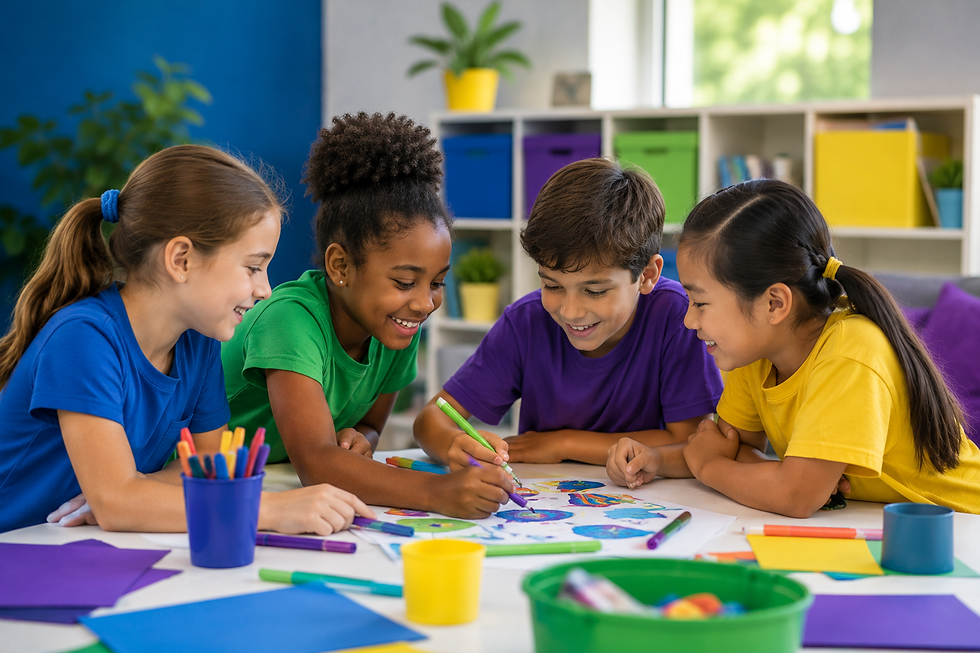
Shared interests reduce some of that pressure by giving children an immediate reason to interact. Instead of trying to invent a conversation with a stranger, your child can talk about the LEGO creation they're building, the game everyone is playing, the book they're discussing, or the art project sitting in front of them.
Research on friendships among children and adolescents has consistently found connections between similarity, shared activities, and friendship formation.
That doesn't mean your child's friends need to be exactly like them. It means having something in common can make that first connection easier.
For a child who struggles to start conversations, "You like that too?" can be a much easier beginning than simply walking up to another child and introducing themselves.
Teach the Skills We Sometimes Assume Kids Already Know
We tell children to "go play" or "go talk to them," but some children genuinely don't know how to enter a conversation or join an activity that's already happening.
Those are skills, and skills can be practiced.
Before an activity, you might casually rehearse a few simple ways to join in:
"What are you guys playing?"
"Can I play too?"
"I like Minecraft too. What do you usually build?"
"Do you want to explore with me?"
"What club are you doing next week?"
You don't need to turn every outing into a social-skills lesson. Just give your child a few tools. For children who feel nervous socially, knowing what they could say can make the situation feel much less intimidating.
Create Opportunities Without Forcing the Outcome
There is an important difference between encouraging connection and demanding friendship. You can create opportunities. You can return to the same activities. You can help your child practice starting conversations. You can invite another family to meet again. You can encourage your child to participate. But you can't choose their friends for them. And you probably shouldn't try.
Your job is to create enough consistent, comfortable opportunities for relationships to develop naturally. That may mean resisting the urge to quit an activity after two visits because your child "didn't make any friends." Unless the environment itself is a poor fit, give familiarity a chance to work.

Ask Whether Your Child Actually Wants More Friends
Sometimes the parent is more concerned about the size of a child's social circle than the child is. One child may want a large group of friends and frequent interaction. Another may be perfectly happy with one or two close friendships.
A child who spends a lot of time alone isn't automatically lonely. So instead of asking only: "Does my child have enough friends?" Ask: "Does my child feel connected?"
Talk with them. Do they wish they had someone to talk to? Do they want to see other kids more often? Is there someone they would like to know better? Do they feel left out when they attend activities? Or are they actually content with a smaller social world?
The goal isn't popularity. The goal is connection that meets your child's needs.
What If They're Going to Activities and Still Feel Lonely?
This is where adding another activity may not solve the problem.
A child can be surrounded by people and still feel alone. If your child attends co-ops, clubs, sports, field trips, or other activities but consistently feels like an outsider, look more closely at what those environments are actually providing. Are they seeing the same children regularly? Is there enough unstructured interaction for kids to talk?
Do they share interests with anyone there? Is the group so large that your child disappears into it? Does your child know how to join what's happening? Are other children welcoming when they try?
You may discover that your child doesn't need more social opportunities.
They need better opportunities for connection. That might mean choosing one recurring club instead of five unrelated events. It might mean inviting one child to do something outside the larger group. It might mean finding a smaller environment.
Or it might simply mean staying somewhere long enough for unfamiliar faces to become familiar ones.
When Shyness Seems Like Something More
Some hesitation around new people can be completely normal, particularly for children who take longer to warm up. But pay attention to how your child feels. If they desperately want friendships but anxiety repeatedly prevents them from participating, they experience significant distress around social situations, or their fear consistently interferes with everyday life, it may be worth talking with your child's pediatrician or another qualified professional.
There is a difference between a child who needs more time and a child who wants to participate but feels unable to. You don't need to label every quiet child as anxious.
You simply want to notice when "I'm not ready yet" begins to look more like "I can't."
Finding the Right Community Matters More Than Filling the Calendar

When your child hasn't found their people, it's easy to feel like you need to solve the problem immediately. You don't. Friendship isn't something you can schedule for Tuesday at 2:00. What you can do is intentionally create the conditions that help friendship grow: Shared interests. Repeated interaction. Familiar faces. Opportunities to practice. Enough time for connection to develop.
That's also part of why FunCation Academy offers FunClubs. They're recurring, interest-based spaces where students can interact around something they already enjoy, see familiar faces again, practice communicating, and have time for relationships to develop naturally.
Because sometimes a child doesn't need someone to tell them:
"Go make a friend." They just need enough opportunities to discover:
"Hey, I like that too."
And eventually:
"These are my people."
Sources:
Child Mind Institute — "Kids Who Need a Little Help to Make Friends." Guidance from clinical experts on helping children develop friendship skills, supporting shy children, practicing social interactions, and recognizing that some children are content with only one or two close friends. Updated July 2, 2026.
Child Mind Institute — "My son is seven years old and seems very shy and lacks confidence when interacting with friends or teachers. How do I help him build self-confidence?" Guidance on helping children gradually practice social communication and recognizing when anxiety may warrant additional professional support. Updated May 13, 2026.
Faur, Sharon & Brett Laursen — "Classroom Seat Proximity Predicts Friendship Formation." Frontiers in Psychology, 2022. Longitudinal research involving children in grades 3–5 found that proximity was associated with friendship formation and that children were more likely to become friends with peers placed near them.
Liberman, Zoe & Alex Shaw — "Children use similarity, propinquity, and loyalty to predict which people are friends." Journal of Experimental Child Psychology, 2019. Research examining how children ages 3–11 use similarity, proximity, and loyalty as cues when reasoning about friendships.
National Research Council — "The Peer Context in Middle Childhood," Development During Middle Childhood. Review of research on children's peer relationships, including the importance children place on spending time together and discovering shared interests and similarities as friendships develop.
Simpkins et al. — "Friends in Activities, School-related Affect, and Academic Outcomes in Diverse Middle Schools." Research discussing how extracurricular settings can support friendship formation through shared experiences, interests, and repeated interaction.


Comments