
My Teen Says They Want to Go to College. Are We Actually Preparing for It?


Your teenager casually says: “I think I want to go to college.” And suddenly, your homeschool brain starts spinning.
Do we have the right credits?
Am I supposed to be making a transcript?
Should they take the SAT?
What about dual enrollment?
Are the classes we're taking actually the ones colleges want?
And then comes the question underneath all the others:
Were we supposed to be preparing for this already?
If you're suddenly looking at college admissions and feeling like everyone else received an instruction manual you somehow missed, don't try to figure out the entire process at once.
College preparation isn't one enormous task.
It's a series of decisions, and you can start with the next one.
First, College Readiness Isn't One Universal Checklist
One of the easiest mistakes to make is searching:
“What classes does my homeschooler need to get into college?”
and expecting one answer. There isn't one.
Colleges establish their own admissions policies, and requirements can vary by institution and even by program. Testing policies can vary too. College Board, for example, specifically advises students to check individual college policies because institutions decide how they'll use SAT scores.
That means your teenager's college preparation shouldn't begin with someone else's generic checklist. It should begin with:
Where might my teen want to go, and what would those schools expect?
Your teen doesn't need to choose their college today.
Start with a small sample, perhaps three to five schools representing different possibilities. Then work backwards.
A Simpler Way to Think About College Planning
Instead of thinking about transcripts, testing, applications, financial aid, courses, and dual enrollment as one giant project, break the process down:
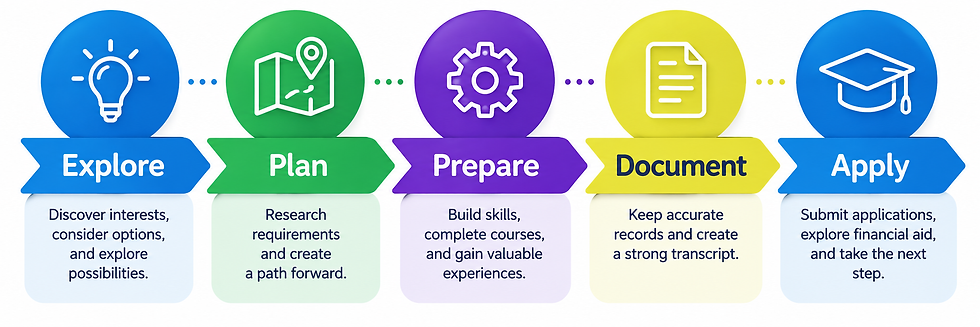
Your family may move back and forth between these areas as your teen's goals change.
The point isn't to create another rigid system.
It's to make college planning feel manageable.
1. Explore: Where Might Your Teen Be Headed?
Before worrying about whether your teenager has the “perfect” transcript, start talking about what they want. Not: “Choose your college right now.”
Instead:
Are there careers they're curious about?
Do any of those careers require a particular degree?
Would they prefer a large university or smaller college?
Do they want to stay close to home?
Would community college make sense?
Are there financial limitations you need to consider?
Is there a particular program or major they're interested in?
“I don't know yet” is a perfectly useful answer.
Exploration is about narrowing possibilities enough that you can begin researching.
Practical Tip: Create a Starter College List
Choose a handful of colleges together, not necessarily because your teen will apply to them, but because they'll give you something concrete to investigate.
Look at each school's official admissions website. What courses do they expect?
What documentation do homeschool applicants submit? What is the school's current testing policy? Are there additional requirements for a particular major?
Now you're planning from actual information instead of guessing.
2. Plan: Work Backward From the Goal
Once college is a realistic possibility, your homeschool high school plan needs to account for more than simply completing your state's homeschool requirements.
Graduating from your homeschool and being prepared for admission to a particular college are two different questions.
Suppose a college your teen is considering expects a certain academic background. That information can influence which courses you choose during high school.
And discovering that in ninth or tenth grade is much easier than discovering it halfway through senior year.
Practical Tip: Do a Course Check Once a Year
At least annually, compare:
What has my teen completed?
What are they taking now?
What do their potential colleges expect?
What should we plan for next year?
As their college list changes, revisit the plan.
You don't need to predict the future.
You need a plan that can change with it.
3. Prepare: College Readiness Is More Than Credits
A transcript can show that your teen completed Algebra II.
It doesn't necessarily tell you whether they're ready to independently manage college life.
College preparation can also include developing skills such as:
managing deadlines,
communicating with instructors,
studying independently,
taking notes,
managing a heavier workload,
asking for help,
writing longer assignments,
organizing their schedule,
advocating for themselves.
This is one area where homeschooling can provide valuable opportunities to gradually transfer responsibility from parent to student.
Instead of managing every assignment for your teenager, begin asking:
What can they start managing themselves?
The goal isn't just getting your teen into college.
It's helping prepare them to function successfully once they're there.
What About Dual Enrollment?

Dual enrollment allows high school students to take college courses while they're still in high school. For the right student, it can be worth exploring.
The U.S. Department of Education's What Works Clearinghouse reports positive effects from dual-enrollment programs in areas including college access and enrollment, college credit accumulation, and degree attainment.
But that doesn't mean every homeschool teenager needs to start taking college classes as quickly as possible. Consider your student's academic readiness, maturity, workload, goals, and the policies of the colleges or programs involved.
Dual enrollment is an option, not a requirement for proving that your homeschooler is college ready.
4. Document: Don't Wait Until Senior Year
This is where homeschool parents can save themselves a lot of stress.
Keep records as you go.
Depending on your homeschool and the colleges involved, useful records may include:
courses completed,
credits,
grades,
course descriptions,
curriculum or materials used,
dual-enrollment coursework,
extracurricular activities,
volunteer experiences,
awards or accomplishments.
Your student's eventual transcript will organize their high school academic record, but good recordkeeping makes that transcript much easier to create accurately.
Create a simple high school folder, digital, physical, or both, and update it regularly.
Future you will be very grateful.
Do Homeschoolers Need the SAT or ACT?
The better question is:
Does my teen need or benefit from a test score for the colleges, scholarships, or opportunities they're pursuing?
College admissions testing policies continue to vary.
College Board states that colleges determine their own policies for how SAT scores are used. Even at test-optional schools, students may choose to submit scores, while particular institutions or opportunities may handle testing differently.
So don't assume:
“Everyone needs the SAT” or “Nobody cares about test scores anymore.”
Research the current policies of the colleges and scholarships your teen is considering.
If testing could be beneficial, build preparation and testing dates into the plan early enough that your teen isn't trying to handle everything at the last minute.
5. Apply: Know What's Coming Before Senior Year
Applications don't need to dominate the early high school years.
But families should understand what's eventually ahead.
Depending on the student's path, senior-year tasks may include:
college applications,
transcripts,
essays,
recommendation requests,
testing or score submissions when applicable,
scholarship applications,
financial aid forms,
college-specific homeschool documentation.
Financial planning belongs in this conversation too.
The Free Application for Federal Student Aid (FAFSA) provides access to federal student aid, including grants, work-study funds, and federal student loans. States, schools, and some private aid providers also use FAFSA information, and deadlines can differ.
Don't wait until applications are due to have the first family conversation about what college might cost. Talk about affordability while you're building the college list.
What If We're Starting Late?

This may be the question worrying you most.
Maybe your teen is already a junior.
Maybe you haven't been keeping beautiful records since ninth grade.
Maybe you've never looked at a college admissions page before today.
Don't spend your energy wishing you'd started sooner.
Start with where you are.
Pull together the courses and records you already have. Identify what your teen has completed. Talk about what they're considering.
Choose a few possible colleges. Look up their current requirements. Then identify the gaps. You may discover you're in better shape than you thought. Or you may discover things that need attention. Either way, now you have information, and information gives you something to work with.
Your Teen Doesn't Need Their Entire Life Figured Out
College planning shouldn't turn every conversation into:
What are you majoring in?
Where are you going?
What career are you choosing for the rest of your life?
Exploration is part of preparation. Let them investigate. Let them change their mind.
Let them discover that a career they thought sounded amazing isn't actually for them.
Your job isn't to have every answer. It's to help them start asking better questions.
You Don't Have to Navigate It Alone
College planning can become complicated quickly because families aren't just managing academics. They're trying to coordinate courses, transcripts, admissions expectations, testing decisions, deadlines, financial considerations, and a teenager whose plans may change along the way.
That's part of why FunCation Academy's College Bound support exists, to help homeschool families navigate the college-preparation process with individualized guidance rather than trying to piece everything together alone.
The goal isn't to take control of your teen's future.
It's to help your family understand the road ahead and make informed decisions along the way.
So...Are We Actually Preparing for College?
You don't need to answer that question by looking at everything you haven't done.
Start with five things:
Explore → Plan → Prepare → Document → Apply
Ask where your teenager might want to go.
Find out what those colleges actually expect.
Build an academic plan around those possibilities.
Help your teen develop the independence they'll need.
Keep good records as you go.
And revisit the plan when their goals change.
You don't need to have four years of college preparation perfectly mapped out today.
You just need to know the next step, and take it.

Sources:
1. College Board — SAT Admissions PoliciesSupports the article's discussion that there isn't one universal SAT requirement and families should check each institution. College Board states that colleges establish their own admissions policies and decide how they use test scores.
2. College Board BigFuture — High School Courses & College PreparationSupports the sections about planning high school coursework around college expectations. Importantly, College Board notes that high-school graduation requirements may not necessarily satisfy the requirements of the colleges a student applies to.
3. College Board BigFuture — College Application Requirements supports our point that families should research individual colleges rather than rely on one generic admissions checklist. BigFuture notes that admissions processes and requested materials can differ among institutions.
4. U.S. Department of Education, Institute of Education Sciences — Dual Enrollment Programs.
5. U.S. Department of Education, Federal Student Aid — The official 2026–27 FAFSA materials show why families need to pay attention to different federal, state, and college deadlines rather than assuming there is one universal financial-aid deadline. 2026–27 FAFSA Form and Deadlines
6. College Board BigFuture — What Classes Colleges Look ForUseful support for the Plan and Prepare portions of our framework. It explains that colleges examine the specific courses students take, progression through core subjects, electives, and academic rigor.


Comments