
Is My Homeschooled Child Falling Behind? How to Recognize the Signs and Help Them Thrive


One of the most common fears homeschool parents have is, "What if my child is falling behind?"
It's a question that keeps many parents awake at night. You chose homeschooling because you wanted the best for your child, but without the daily comparisons of a traditional classroom, it can be difficult to know whether they're truly learning or simply moving through lessons.
The good news is this: being "behind" isn't always what it seems. Every child learns differently, develops at a different pace, and has unique strengths. The goal isn't to keep up with everyone else; it's to make sure your child continues making meaningful progress.
"What if my child is falling behind?"
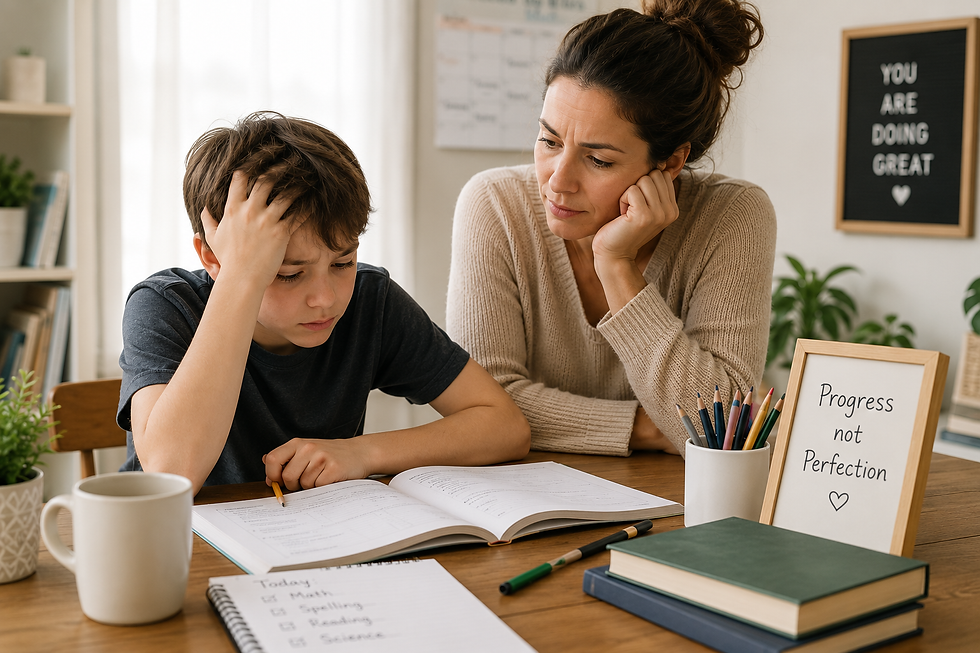
First, Let's Redefine "Behind"
Traditional schools often measure success by age-based standards, completed assignments, and grades. Homeschooling gives families the freedom to focus on something far more important: mastery.
A student who takes a little longer to truly understand fractions is often in a much stronger position than a student who memorized enough to pass a quiz but forgot the material a week later.
"Homeschooling gives families the freedom to focus on mastery."
Instead of asking, "Is my child behind?" try asking:
Can they explain what they learned in their own words?
Can they apply the concept to a new situation?
Do they feel confident instead of guessing?
Are they building on previous knowledge?
These questions reveal far more than a test score ever could.

Signs Your Student May Need Extra Support
Every student struggles from time to time. That's a normal part of learning. However, some patterns suggest your child may benefit from additional practice or a different approach.
They struggle with the same concepts repeatedly.
If multiplication facts, reading comprehension, grammar, or another skill remains difficult despite multiple lessons, there may be a learning gap that needs attention.
They become frustrated quickly.
When learning consistently leads to tears, avoidance, or anxiety, it's often a sign that the work is either moving too quickly or foundational skills need strengthening.
They can complete assignments but can't explain what they learned.
Finishing lessons doesn't always equal understanding. Ask your child to teach the concept back to you. If they struggle to explain it, they may need additional practice.
They avoid certain subjects.
Many students avoid the subjects where they lack confidence. Avoidance is often a clue that they need encouragement and targeted support rather than more pressure.
They forget material soon after learning it.
If concepts seem to disappear after a quiz or lesson, your child may need spaced review and more opportunities to practice.
What You Can Do
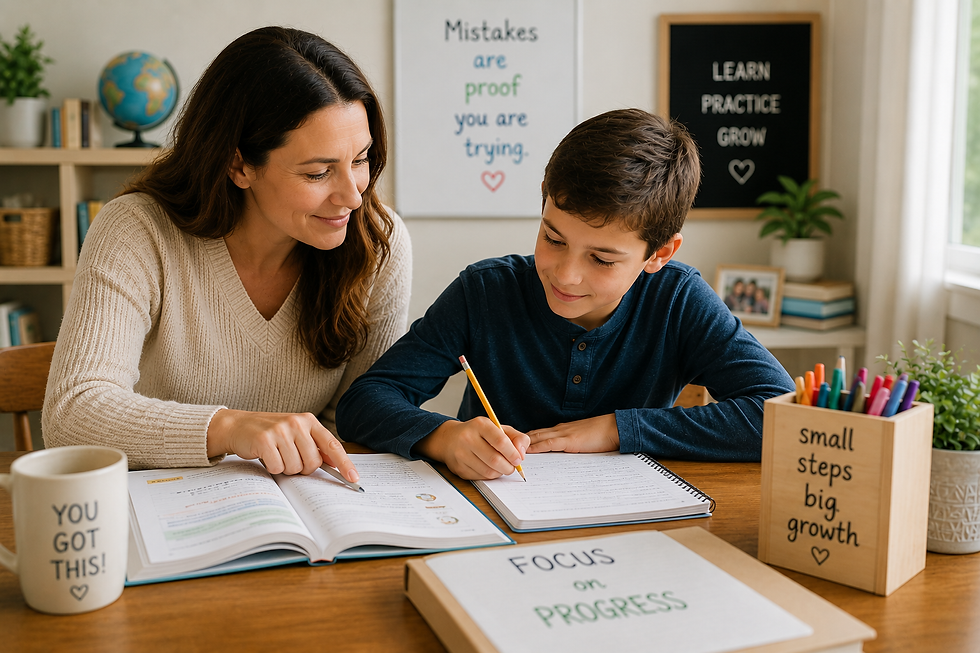
The encouraging news is that learning gaps can be addressed. They don't define your child's future.
"Learning gaps don't define your child's future."
Start with observation, not panic.
Spend a week simply watching your child's learning habits.
Notice:
Which subjects come naturally?
Which ones consistently cause frustration?
Are mistakes due to lack of understanding or rushing?
Do they need more practice or a different explanation?
Small observations often reveal the real issue.
Focus on one challenge at a time.
Trying to fix everything at once can overwhelm both you and your child.
Choose one skill to strengthen first. Success builds confidence, and confidence makes future learning easier.
Provide additional practice.
Most students don't need an entirely new curriculum.
They simply need more opportunities to practice the concepts they haven't yet mastered.
Look for activities that reinforce learning through games, real-life applications, discussion, or short targeted practice sessions instead of lengthy worksheets.
Celebrate progress.
Growth rarely happens overnight.
Celebrate small victories:
Reading one level higher
Solving a difficult math problem independently
Writing a stronger paragraph
Remembering yesterday's lesson
These moments matter.

Remember: Learning Isn't a Race
One of homeschooling's greatest strengths is the freedom to slow down when necessary.
Children don't all learn on the same timeline.
Some readers bloom early.
Others become confident readers later and go on to excel academically.
The same is true for math, writing, science, and every other subject.
Progress is far more important than pace.
"Children don't all learn the same."
You Don't Have to Do It Alone
Every homeschool parent reaches moments of uncertainty.
Asking for extra help doesn't mean you've failed; it means you're paying attention to your child's needs.
Sometimes that support comes through additional practice, encouragement, community, or supplemental learning resources that reinforce difficult concepts without adding unnecessary stress.
The important thing is recognizing that learning gaps can be filled, confidence can be rebuilt, and students can absolutely catch up.
Sometimes that support comes through encouragement, community, or structured supplemental learning that helps fill in gaps without overwhelming your child or your schedule.
This is where FunCation Academy can help.
At FunCation Academy, we support homeschool families by providing flexible, mastery-based learning programs designed to meet students exactly where they are. Whether your child needs to strengthen foundational skills, rebuild confidence, or get extra practice in a specific subject, our approach is designed to reduce stress—not add to it.
Instead of forcing students to move on before they're ready, we focus on helping them truly understand the material so they can move forward with confidence. Parents get support, students get clarity, and learning becomes less overwhelming for everyone involved.
The important thing is recognizing that learning gaps can be filled, confidence can be rebuilt, and students can absolutely catch up—with the right support system in place.
The Bottom Line
If you're worried your child may be falling behind, remember this:
Your child is not defined by a single difficult subject, a missed concept, or a slower pace.
With patience, consistent practice, and the right support, students grow in both knowledge and confidence.
Homeschooling gives you something incredibly valuable: the ability to meet your child exactly where they are and help them move forward one step at a time. And with support from tools like FunCation Academy, you don’t have to navigate that journey alone.
And sometimes, that's the greatest educational advantage of all.
Sources:
National Center for Education Statistics (NCES)
Information on student achievement, academic progress, and educational assessment.
Supports the discussion that students develop at different rates.
National Home Education Research Institute (NHERI)
Research on homeschool student outcomes and academic achievement.
Supports the discussion that homeschooling allows individualized pacing.
National Association for the Education of Young Children (NAEYC)
Articles on child development and the fact that children reach milestones on different timelines.
Supports the section redefining "behind."
Carol Dweck
Research on Growth Mindset.
Supports the encouragement to celebrate progress rather than perfection.
Mindset: The New Psychology of Success.
John Hattie
Research demonstrating the impact of feedback, deliberate practice, and teacher-student relationships.
Supports the recommendations for observation, targeted practice, and encouragement.
Visible Learning.
Benjamin Bloom
Research on Mastery Learning.
Supports the article's emphasis on mastery over simply completing assignments.
Learning for Mastery (1968).
American Psychological Association
Research on motivation, learning, and resilience.
Supports the discussion of confidence and academic persistence.


Comments